The Long-Term Benefits of Keeping Tarantulas in Bioactive Terrariums

I started keeping a lot of my tarantulas in bioactive enclosures a couple of years ago for two simple reasons.
First, I wanted the enclosures to look better. I wanted something that looked less like a spider living in a plastic box filled with dirt and more like a small piece of the environment that species might encounter in nature. I’d love to tell you there was some deep scientific motivation behind that decision, but initially a lot of it was aesthetic. I photograph these animals, I spend hours looking at them, and I wanted their enclosures to look alive, and fake plants and backgrounds were not cutting it.
Second, I was getting tired of some of the problems that came with simpler setups. Coco fiber worked, but every time it stayed damp, I seemed to get ugly yellow mushrooms, mold, grain mites, or some other harmless but annoying little organism that had decided my tarantula enclosure was now their home too. I hoped a living substrate with plants, beneficial microorganisms, and springtails would create a more balanced environment and make maintenance easier.
After a few years of doing this, both of those things happened, but not in the way I expected.
I wouldn’t say bioactive enclosures require less maintenance. The plants need trimming, and the moisture and nutrients need to be monitored. Springtail populations occasionally need replenishing, as do the leaves as they break down and the substrate as it settles. Eventually plants outgrow the enclosure, and every now and then something goes sideways, but I get a whole lot more for roughly the same amount of work. The best part is I started seeing behaviors from my tarantulas that I rarely saw when I kept them in simpler enclosures. The more natural the environment, the more natural their behavior.

What I Mean by Bioactive Has Changed
When I first got into bioactive keeping, I think I assumed a bioactive enclosure meant soil, plants, springtails, and isopods. Maybe I just liked the idea of it because there was something cool about having several different kinds of invertebrates living together in this tiny ecosystem, all doing their part like they would outside.
After working with these enclosures for a few years, the springtails and isopods are almost the least interesting part of what makes an enclosure bioactive. For me, bioactive now means creating a functioning living substrate. There are beneficial microorganisms breaking down organic material. Plant roots move through and stabilize the soil. Leaves and moss slowly decompose. Moisture moves through different layers. Plants grow above the surface while roots create structure below it. Springtails feed on fungi and decomposing material and become another piece of that cycle. The enclosure starts functioning like a tiny environment instead of a container filled with substrate.
That distinction also changed the way I think about cleanup crews. I rarely use isopods in tarantula enclosures, if ever. Some isopods are very protein-motivated, and a freshly molted tarantula is about as defenseless as an animal can get. Springtails are generally more than enough for what I need them to do in a tarantula enclosure. You absolutely do not need isopods for an enclosure to be bioactive.
Natural Enclosures Produce Natural Behavior
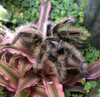
This has probably been the biggest benefit for me. Once you start adding plants, branches, cork bark, moss, and leaf litter, the enclosure stops feeling like an empty box and starts giving the spider things it can actually use. Arboreal species have more anchor points for webbing, fossorial species can burrow around plant roots that help hold the soil together, and broad leaves and moss create shaded, more humid pockets throughout the enclosure. All of that extra structure gives the spider more ways to move around, hide, and choose where it feels comfortable without having to stay completely exposed.
I’ve been fortunate enough to see some of this behavior in the wild, and those experiences have completely changed the way I build enclosures. While I was in Martinique, I documented juvenile Caribena versicolor using their webbing to curl broad leaves around themselves, creating these tubular retreats. Watching them manipulate living plants that way made me realize how much behavior we remove when an arboreal spider is kept in an empty glass enclosure with just one big piece of cork bark. When you add something like pothos into that enclosure, suddenly the spider has broad leaves it can pull together, web behind, climb through, and use as cover.
In Peru, we found Hapalotremus living beneath large rocks surrounded by moss. Even though the environment was pretty arid, that moss was part of the microhabitat surrounding the spider's retreat, helping create cooler, damper conditions beneath the surface. Those kinds of observations have influenced almost everything I do now.
My goal isn't necessarily to recreate exactly what the landscape looks like where the spider is native. I'm trying to recreate the conditions the spider is searching for within that landscape. During the hottest part of the day, wild tarantulas aren't sitting exposed where we record the temperature and humidity. They're underground, inside a tree hollow, beneath a rock, deep in a crevice, or tucked into some protected space where conditions are cooler and more stable. I don't keep my spider room at 90°F because a species comes from a place where daytime temperatures reach 90°F. I keep most of the room comfortably in the mid 70s. There are exceptions, especially with certain highland species, but generally speaking, temperatures that are comfortable for us work very well for most commonly kept tarantulas. This article goes in to depth on tarantula heating methods.
Then I use the enclosure to provide additional microclimates. A spider can move beneath a plant, inside cork bark, deeper into a burrow, onto dry substrate, toward a damp area, or out into the open. When I give them those choices, I've noticed that species that usually spent most of their time hiding in simpler setups are much more willing to sit out in the open. My assumption is that they know they can disappear whenever they want. I can't scientifically prove that my tarantulas are "happier," and I don't really like projecting human emotions onto spiders anyway. What I can say is that I regularly see less defensive behavior and more natural activity when they have abundant cover and multiple secure retreats. They seem much more comfortable sitting exposed when cover is only a few inches away.
Plants Do More Than Look Good
Once the plants establish themselves, the enclosure starts looking natural quickly. Eventually the problem becomes keeping everything trimmed so your little slice of rainforest doesn't turn into a pothos enclosure. Living plants also contribute to the enclosure's moisture cycle, provide shade, stabilize substrate with their roots, and create physical structure the spider can use. Here's a video about how to maintain plants in a bioactive terrarium.
Choosing those plants wisely has been one of my bigger learning curves. I've put plants into enclosures that looked perfect when they were four inches tall and then discovered six months later what a mistake I had made. Pothos is one of my favorites because it is inexpensive, hardy, and provides excellent broad-leaf cover, but it can get out of hand quickly. Vines will find ventilation holes, lid seams, door gaps, and any other possible route out of the enclosure. If you ignore it long enough, it can create a gap large enough for the spider to exploit. I've never had that happen, but I've seen enough determined pothos vines trying to lift lids that I keep an eye on them.
Plants can also become root-bound. Eventually, a root system may become so dense that removing the plant is the only practical option. Unfortunately, pulling a mature plant out can destroy a burrow the spider spent months constructing. When that happens, I remove the spider first, disturb as little of the surrounding enclosure as possible, replace the plant with something more appropriately sized, and then return the spider. Choosing the right plant from the beginning saves everybody some aggravation and urticating hairs.

Bioactive Spiderlings Changed My Mind
One of the biggest changes in my own husbandry has been spiderlings. I originally thought full bioactive setups for tiny slings were unnecessary and potentially even risky. Why go through all that work for a spider living in a tiny enclosure? Then I started finding spiderlings in the wild.
Tiny tarantulas don't grow up in sterile little cups. They live in an incredibly complex layer of soil, plant roots, moss, decomposing leaves, microorganisms, fungi, and other tiny invertebrates. I started looking at sling enclosures differently because spiderlings are usually kept in very small containers, and waste and leftover organic material are concentrated into a much smaller volume. Having springtails and a functioning substrate in there makes even more sense to me now. That doesn't mean their enclosures need to be elaborate miniature jungles. Sometimes it is simply Terra Aranea, a little sphagnum moss and leaf litter, springtails, a tiny piece of cork bark, and appropriate moisture. I am changing the scale but not the basic idea.
Stop Trying to Make Everything Bioactive
My opinion moved in the opposite direction with many desert species. For a while I tried to figure out how to maintain enough moisture in enclosures for species like Aphonopelma, so springtails and plants could remain active. Essentially, I was trying to build a little forest ecosystem around a spider that didn't live in anything resembling a forest.
Then I went to the Sonoran Desert. We found species like Aphonopelma chalcodes and Aphonopelma vorhiesi living in ground that was dry, compact, sandy, and clay-like at the surface. As we dug deeper, the soil gradually became cooler and slightly more moist.
That told me much more than staring at humidity percentages ever did, and now I try to recreate that structure instead. The surface stays predominantly dry while the deeper layers retain a little moisture, giving the spider room to dig down into cooler, more stable conditions. I’ll occasionally overflow the water dish in one corner and may keep a small patch of moss nearby, although I rarely see the spiders choose the damp area over dry substrate. I’ll use drought-tolerant plants like small succulents where appropriate, but I don’t force enough moisture into the enclosure just to keep springtails alive.
This type of setup still has plenty of biological activity below the surface. Bacteria, fungi, plant roots, and other microorganisms are still breaking down organic material and interacting with the soil, even if the enclosure is too dry to support the kind of visible clean-up crew we associate with bioactive keeping. At that point, whether somebody wants to call it fully bioactive or simply naturalistic matters a lot less to me than whether the enclosure matches the conditions the spider is adapted to thrive in.
Bioactive Does Not Mean Maintenance-Free
One thing I definitely learned pretty quickly is that bioactive doesn’t mean maintenance-free. You’re still putting work into the enclosure; it’s just a different kind of work. Instead of periodically dumping everything out and starting over with fresh substrate, I’m trimming plants, replacing leaf litter, keeping an eye on the springtails, adding a little fresh substrate as the older material settles, and making sure the moisture levels stay where they need to be.
The nice part is that, when everything is healthy, you can keep that same living substrate going for years instead of treating it like something disposable. I’ve done exactly that with several of my Theraphosa setups, carrying established substrate forward as the spiders outgrew their enclosures and mixing it into fresh Terra Aranea in the larger setup.
As the substrate settles over time, I’ll top it off with fresh material, keep an eye on the springtail population, and add a little food or a fresh culture if their numbers start to drop. For older established setups (6 months to a year old), I add a little BioVive to help replenish the soil and restart the processes began by the BioShot that I used in the initial build. So bioactive hasn’t eliminated maintenance, but it has made that maintenance feel a lot more worthwhile. I’m spending about the same amount of time caring for an enclosure that actually looks and functions like a living habitat instead of periodically dumping out a box of coco fiber, sterilizing everything, and starting all over.
Mistakes Are Part of the Process
There is definitely a learning curve, and I’ve made my share of mistakes along the way. I had several enclosures hooked up to an automatic misting system at one point, and one of the lines kept siphoning water after the system shut off. It slowly dripped into an enclosure all night until I came in the next morning and found nearly half of the enclosure flooded. Thankfully, I caught it before it became a serious problem, but it was a good reminder that anything automated still needs to be closely monitored.
Some of the harder lessons have been a lot less obvious. I had one tropical enclosure where the moisture gradient looked perfect from the front. One side was dry, the other was damp, and I could see plenty of moisture down in the lower layers of substrate. What I didn’t realize was that the enclosure was sitting at a slight angle, so most of the water I added was running forward and settling along the front glass. From where I was standing, it looked like the entire lower layer was properly hydrated when most of the substrate toward the back was actually bone dry. I didn’t catch it until one of the plants in the rear started wilting.
Now I make a point of checking moisture from several sides and paying attention to how the substrate actually absorbs water instead of judging everything by what I can see through the front. If water suddenly starts pooling, running toward one area, or the substrate stops absorbing it the way it normally does, that is usually my first clue that something below the surface is starting to get out of balance.
Knowing When Something Is Out of Balance
After maintaining these setups for a few years, I’ve gotten much better at recognizing when something is starting to go wrong. Healthy Terra Aranea has some structure to it. It should absorb water, stay relatively loose and aerated, and have enough organic material mixed through it that roots, springtails, and microorganisms can all do their thing. When the substrate starts looking compressed, soupy, or swampy, or water suddenly sits on the surface instead of soaking in normally, I know I need to start figuring out what changed.
Sometimes I’ve simply been adding too much water, but the problem can also be hidden below the surface. A plant may have become root-bound, roots may be starting to rot, or years of settling and plant growth may have compacted sections of the substrate enough to interfere with drainage and airflow. That can make these problems a little tricky because by the time you notice something above ground, it may have been developing underneath for a while. I’ve learned to pay attention to the plants as much as the substrate. Leaves starting to yellow, droop, or suddenly die back can be one of the first signs that moisture, nutrients, or the condition of the soil has changed.
Mold is another thing I look at differently now than I did when I started. A little fungal growth in a newly established enclosure doesn’t bother me, and neither does the occasional mushroom. There is decomposition happening in a healthy living substrate, so seeing fungi every now and then isn’t automatically a problem; in fact, it is kind of exciting. If an enclosure that’s been stable for months suddenly develops a heavy layer of fuzzy mold, though, I start checking the moisture level, ventilation, springtail population, and the health of the plants because something has probably shifted in the wrong way.
Probably the easiest way I’ve learned to judge an established enclosure is simply by how it smells. A healthy bioactive setup has that earthy smell you get walking through the woods after a storm. You can smell damp soil, leaves, plants, and a little bit of natural decay, but it smells fresh and alive. If I open an enclosure and get a sweet, stagnant, sour, or rotten smell, that gets my attention immediately. I may not know exactly what is wrong yet, but after spending enough time around these setups, my nose usually tells me there is a problem before I can see it.
Mold Is Not Always the Enemy
I used to see a mushroom or a patch of fungus in an enclosure and assume something was wrong. Now I look at the bigger picture. In a living substrate, some fungal activity is normal, especially when a setup is new or when fresh wood has just been introduced. Over time I’ve also learned which types of wood actually hold up well in humid enclosures and which ones don’t. Cork bark has been one of the most reliable because it is lightweight, resistant to decay, and works well for hides and structural support. Mopani and manzanita have also held up well for me, while sandblasted grapevine is something I generally save for much drier setups.
Even good wood can develop a temporary fungal bloom at first. It may look ugly for a little while, but if the enclosure has good ventilation and isn’t staying overly wet, it usually clears up on its own. The springtails will work on the fungus and decomposing material, and sometimes the bloom simply runs out of whatever was feeding it. Once that initial growth disappears, I rarely see it come back unless moisture, airflow, or something else in the enclosure starts getting out of balance.
The Cost Isn't as Bad as It Looks
One of the biggest objections I hear about bioactive setups is the upfront cost, and to be fair, the initial setup is definitely more expensive. A bag of Terra Aranea costs more than a compressed brick of coco fiber, and once you add cork bark, moss, leaf litter, springtails, and live plants, the difference adds up pretty quickly.
The thing is, they are not really doing the same job. Coco fiber is a cheap substrate. Here's why The Bio Dude doesn't recommend it for bioactive setups. A good bioactive substrate supports plant roots, microorganisms, moisture gradients, burrows, and a functioning cleanup crew, and if you maintain it properly, you can keep using that same substrate for years. I rarely throw healthy Terra Aranea away. As a spider grows, I’ll usually carry some of that established substrate into the larger enclosure and mix it with fresh material instead of starting from scratch every time.
Most of the other pieces are not especially expensive either. Pothos and other hardy plants are cheap, easy to propagate, and before long you usually have more cuttings than you know what to do with. Cork bark lasts a long time, and leaf litter and moss can be replaced as needed instead of constantly rebuilding the whole enclosure.
Aesthetically, there is really no comparison for me. I have nothing against artificial plants, and they can provide useful cover, but even the nicest fake plant still looks fake sitting next to something that is actually growing. Living plants put down roots, create shade, interact with the moisture in the substrate, and change the enclosure over time. They make the setup look alive because it actually is.
What I Use
After a couple of years of experimenting with different substrates, plants, woods, and other materials, my basic setup has become pretty simple. For most tropical and temperate tarantulas, I start with Terra Aranea and mix in some sphagnum moss and crushed leaf litter, then add BioShot and enough water to get the substrate to the moisture level I want. From there, I usually build the enclosure around cork bark rounds, flats, or branches because cork is lightweight, holds up extremely well in humid conditions, and gives the spider plenty of places to hide, climb, burrow beneath, or attach webbing.
I use a lot of Bio Dude's live pillow moss and sheet moss as well. I usually soak it first and then cut or tear pieces to fit into corners, crevices, around cork bark, or wherever I want to create a little pocket of moisture and cover. I scatter broken leaf litter and some dry sphagnum moss across the surface to add texture and keep everything from looking too clean and landscaped. When I want to add some rockier areas, I also use Exo Terra Stone Desert to build small outcrops or ledges. It mixes well with the other materials and makes it possible to create sections that look a lot more like exposed rock and compact earth instead of just another enclosure full of brown substrate.
So most of my setups are some combination of Terra Aranea, BioShot, cork bark, live moss, sphagnum moss, leaf litter, springtails, live plants, a water dish, and occasionally Exo Terra Stone Desert. None of those individual ingredients are particularly complicated. The real trick is learning which ones actually make sense for the species you're keeping and using them to create the kind of environment that spider would be looking for in nature.
Two Years Later, Would I Still Recommend It?
Yes, but I think the benefit increases with the complexity of the species you are keeping.
A lot of the classic beginner tarantulas, especially genera like Aphonopelma and Brachypelma, come from relatively dry scrubland or arid environments. You can absolutely build them beautiful naturalistic enclosures, but they do not necessarily need a complicated bioactive system to thrive. In some of those setups, I have found that the cleanup crew ends up confined to the few damp areas where it can survive, which defeats a lot of the purpose.
Where bioactive husbandry really starts paying off for me is with more advanced species from humid forests and more complex microhabitats. Genera like Theraphosa, Poecilotheria, Omothymus, Melopoeus, Caribena, and Cyriopagopus give you a lot more reason to create deep living substrate, healthy plants, stable moisture gradients, shaded retreats, webbing anchors, and a functioning biological system. Those are also the species where enclosure design can have a much bigger effect on how secure the spider feels and how easily you can maintain them without constantly disturbing them.
So after two years, I wouldn’t say every tarantula needs to be kept bioactive. I’d say the more complex the animal's natural environment and husbandry needs become, the more value I see in giving them a more complex enclosure. If I am going to keep a more advanced species, I think it makes sense to give them a more advanced setup.
Written by Richard Stewart of Tarantula Collective 9/16/2026
- Josh Halter