Gooty Sapphire Ornamental Tarantula Caresheet and Bioactive Habitat Maintenance

Poecilotheria metallica
Difficulty Level: Advanced
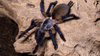
These tarantulas are famous for their metallic blue legs, intricate grey, black, and white patterning, bright yellow markings underneath, and impressive adult size of approximately 6 to 8 inches in diagonal leg span. Native to the Eastern Ghats of southern India, the Gooty Sapphire Ornamental is an arboreal Old World tarantula with a fast growth rate and equally impressive speed. They lack urticating hairs and possess medically significant venom, so handling is not recommended and I would consider this an advanced species rather than one for beginner keepers.
That being said, they are usually retreat-oriented and prefer to hide rather than give a threat pose when given the opportunity, although they are capable of defensive behavior when cornered. In my personal experience, the P. metallicas I have worked with never showed defensive behavior unless I was doing something that irritated them. They are highly photosensitive and will take cover as soon as the lights come on, but after time and with sufficient retreats, they are out on display with surprising frequency.
Poecilotheria metallica is hardy in captivity once you understand their basic needs. Give them a secure vertical retreat, good airflow, access to moisture without keeping things swampy, and enough hiding spots to disappear when they want to, and they’re very straightforward to keep. They are also a relatively fast-growing species, and females can commonly live around 10 to 15 years in captivity, while males are considerably shorter-lived.

Natural History, Description, and Related Species
Poecilotheria metallica was described by British zoologist Reginald Innes Pocock in 1899, and the first specimen known to science was a female associated with Gooty in what is now Andhra Pradesh, India. Although the original female was reportedly collected around the railway timber yard at Gooty, later researchers have suggested the spider may have arrived there accidentally with transported timber. So despite the common name "Gooty Sapphire," Gooty itself doesn’t really represent the species' natural habitat.
For years, the species was believed to have a very restricted distribution in the Eastern Ghats between Nandyal, and that tiny known range helped contribute to its Critically Endangered status on the IUCN Red List. Then in 2019, a paper published in the Journal of Threatened Taxa documented P. metallica at Pakkam Malai Reserve Forest in Tamil Nadu, roughly 230 miles south of its previously confirmed range! That doesn’t mean they’re common or widespread, but it does tell us that we still have a lot to learn about where these spiders actually live.
The habitat information is especially interesting for keepers, because the area sits at roughly 1,300 feet in elevation and includes rocky terrain surrounded by dry thorn scrub, tropical dry deciduous forest, and tropical dry evergreen forest. Annual rainfall was reported around 28 inches, with obvious seasonal differences between the monsoon and dry parts of the year. The researchers even found P. metallica inside caves as well as around the entrance and along dry rocky channels. So they’re a lot more complicated than the old description of a tropical tree spider living in a permanently humid forest.
Poecilotheria metallica is still an arboreal tarantula that makes excellent use of tree cavities, loose bark, crevices, and elevated retreats, but these newer observations show how important protected microhabitats are. These spiders are using enclosed spaces to buffer themselves from the hotter, drier conditions outside.
Conservation Status
Poecilotheria metallica is still listed as Critically Endangered by the IUCN based on its 2008 assessment. Habitat loss, forest degradation, fragmentation, and collection for the exotic pet trade have all been identified as threats. That assessment came out before the 2019 range extension, so our understanding of the species' true distribution has changed since that original evaluation. In 2026, the Andhra Pradesh Forest Department and Eastern Ghats Wildlife Society began a dedicated conservation survey in the Nagarjunasagar-Srisailam Tiger Reserve to collect better information on population size, distribution, habitat use, and current threats.
The entire genus Poecilotheria is also listed under CITES Appendix II, which regulates international trade, and P. metallica receives legal protection within India. Fortunately, this species has become well established in captive breeding programs all over the world. Despite being rare and threatened in the wild, captive-bred P. metallica are usually available in the hobby. There is no good reason to purchase a wild-collected animal. Always buy captive-bred specimens from reputable breeders and dealers.
Recommended Supplies for a Gooty Sapphire Ornamental Tarantula
For a naturalistic or bioactive Poecilotheria metallica enclosure, I recommend:
- A secure, vertically oriented arboreal enclosure
- Terra Aranea Bioactive Substrate or Terra Aranea Bioactive Substrate Kit which contains many of these elements
- Cork bark rounds or large vertical cork flats
- Leaf litter
- Sphagnum moss for localized moisture pockets
- BioShot for bioactive setups
- Tropical springtails
- A shallow water dish
- Live plants for hiding and web anchors
- Long feeding tongs or hemostats
- A catch cup that stays nearby during maintenance and rehousing
For this species, I generally prefer springtails over larger isopods. Springtails can help control mold and break down small amounts of organic material without adding a larger clean-up crew that may bother the tarantula during a molt.
Enclosure Size and Setup
Spiderlings
Spiderlings don’t need a huge enclosure, but they still need vertical structure.
Use a small, secure arboreal sling enclosure with good cross-ventilation. Fill roughly the bottom third to half with Terra Aranea and place a small piece of cork bark vertically against one side. I like to leave a narrow gap behind the bark because many spiderlings will immediately turn that space into a webbed retreat.
You can add a little leaf litter and a small patch of sphagnum moss near one corner to create a localized moisture reserve. Keep the lower substrate slightly moist, but don’t keep the entire enclosure saturated. I like to keep a water dish in all their enclosures, even as spiderlings. You can find micro water dishes or use small bottle caps so your spider always has access to clean drinking water.
Spiderlings are often much more secretive than people expect. Give them somewhere dark and secure to hide and let them settle in rather than constantly pulling apart the retreat to make sure they are still alive. I promise, the spider usually knows where it is.
Juveniles
As the tarantula grows, move them into a taller enclosure with enough vertical space to climb and establish a proper retreat. I like to give them 3 to 4 inches of Terra Aranea depending on the enclosure size, along with a vertical cork bark round or curved flat that reaches most of the height of the enclosure. Add small branches like these, plants, or additional cork pieces around the main hide to provide web anchors and visual cover. They really like to have a few good hiding spots nearby.
Juveniles are fast and capable of squeezing themselves through very small gaps, so enclosure security is extremely important at this stage. Make sure the ventilation holes and gaps in the doors and lids are appropriately sized for your spider and that all doors and lids can lock securely. If they can squeeze their carapace through a gap or hole, they can manage to get their legs and abdomen through it as well.
Keep the lower portion of the substrate slightly moist while allowing the surface to dry. A full water dish should always be available as well as some damp moss in the corner to help maintain a stable humidity.

Adults
An adult P. metallica is going to need a secure vertical 12" x 12" x 18" terrarium or larger, depending on the size and layout. You need to provide enough height for the spider to climb naturally and have plenty of areas to retreat and hide away. I like to give them a large cork bark round, because it recreates the protected hollow spaces they naturally seek. You can also use a wide cork flat or half round positioned against the back wall to create a dark vertical hide where they can feel protected.
I use around 4 to 6 inches of Terra Aranea in the bottom. Although this is an arboreal species, deeper substrate provides moisture buffering, gives live plants room to root, stabilizes cork bark and other hardscape, and offers some protection if the spider ever ends up on the ground. I also scatter leaf litter, a little gravel, and broken-up pillow moss along the ground for a natural aesthetic and to provide microclimates for the springtails. I also plant some pothos or other low-light, terrarium-safe tropical plants and a few small cork bark branches or small spider wood branches for enrichment and cover.
The best setup lets your spider disappear completely, which sounds strange when you just spent money on one of the most beautiful tarantulas in the world, but a secure tarantula is often a more visible tarantula. When they know they have somewhere safe to retreat, they are much more comfortable sitting near the entrance and coming out after dark.
Substrate and Humidity
Older care sheets often recommend maintaining P. metallica at a specific humidity percentage, but I don’t think that is the most useful way to approach this species. Their natural habitat experiences extreme seasonal changes. The 2019 Tamil Nadu study reported roughly 28 inches of annual rainfall, with surface temperatures reaching around 86 to 97°F during the non-monsoon season and dropping closer to 75°F during the monsoon, but the tarantulas are not standing outside in the midday sun with a thermometer. They are using tree cavities, bark, rock crevices, caves, and other protected retreats where conditions are much more stable.
In captivity, recreate the microclimate, not the weather report. Keep a water dish full at all times. Maintain some moisture in the lower substrate while allowing the surface and upper enclosure to dry between waterings. Occasionally overflowing the water dish or watering one side of the substrate works better than constantly misting every surface.
I keep my slings slightly more humid than adults because their smaller bodies lose moisture a lot more quickly, but they still need good cross-ventilation. Their enclosure should never smell stagnant or remain constantly wet or swampy. Terra Aranea works especially well here because it can hold the moisture deeper in the enclosure while allowing the surface to dry. A little sphagnum moss tucked into one lower corner can create another localized moisture pocket without turning the enclosure into a swamp.
Temperature
Keep P. metallica at normal, comfortable room temperatures, generally around 70 to 78°F.
You do not need to reproduce the 90°F daytime temperatures that occur in parts of their natural range. Those temperatures describe the environment outside the spider's retreat, not necessarily the conditions where the tarantula is spending the hottest part of the day. That being said, it is important to note that if you are attempting to breed this species, you will need to provide a sustained temperature of over 80°F for several days before the female will drop her egg sac.
I do not recommend heat lamps or under-tank heaters for tarantulas. If your room is consistently too cold, warm the room rather than creating a dangerously hot spot inside the enclosure. If supplemental heating is absolutely necessary, then you will need to use a small heat mat on the side of the tank with a thermostat and make sure the probe is properly placed and calibrated to avoid fire hazards and overheating your spider.
Ventilation
Good ventilation is extremely important with all Poecilotheria species. Humid conditions do not mean stagnant conditions. Cross ventilation allows moisture to move through the enclosure without trapping constantly wet air around the spider. This is important in bioactive setups where live plants and organic material are already contributing to humidity.
An arboreal enclosure should provide ventilation both low and high when possible so fresh air can move throughout the vertical space. Don’t compensate for poor ventilation by simply keeping the enclosure dry. Give the spider moisture and airflow at the same time, even if you have to do a little DIY.
Venom and Safety
Poecilotheria venom deserves your respect. There are documented human bite reports from this genus involving severe localized pain and prolonged muscle cramps. Symptoms have sometimes lasted for days, and Old World tarantula bites should be taken seriously.
There are no urticating hairs to act as a first line of defense, so if escape fails and the spider is cornered, biting is one of the only tools it has left. That does not make P. metallica aggressive or eager to bite, but it does mean you should design your husbandry so a bite never needs to happen. Use long tools. Keep a catch cup nearby. Know where the spider is before opening the enclosure. Work in a controlled space during rehousing, and never put your hands into a retreat if you cannot see inside.
Good husbandry is the best safety equipment you have!
Rehousing
You need to plan the rehousing before you open either enclosure. First, you need to completely set up the new enclosure. Have the cork bark, substrate, water, plants, and decor already in place. Put both enclosures inside a large plastic tote, bathtub, or another controlled area where an unexpected bolt is easy to contain.
Give the spider a clear route from the old enclosure into the new one and encourage movement gently with a long paintbrush or similar tool. Do not chase the tarantula around the enclosure. Calm, slow movements from you usually produce calmer movements from the spider. Constant poking or blowing tends to produce exactly the kind of speed everyone warns you about.
Once the spider enters their new enclosure, secure the lid or shut the door before doing anything else.
Breeding and Captive Conservation
Poecilotheria metallica has been bred successfully in captivity for years, and established captive breeding is one of the bright spots in the story of this threatened species.
Females should be mature, well established, well fed, and healthy before attempting to pair with a male. Introductions should be closely monitored, and the male should always have room to escape. Their mating rituals involve the typical tapping and vibration through the webbing. Cannibalism is possible, as it is with most tarantulas, but successful pairings are common among experienced breeders where the male isn’t immediately eaten so he can be passed on to other females.
The most important part of breeding this species is not chasing maximum production. It is maintaining healthy captive bloodlines and making captive-bred animals readily available, so there is no reason to ever remove these spiders from the wild.
Final Thoughts
Poecilotheria metallica is one of those tarantulas that deserves every bit of the reputation they have earned, although probably not for the reasons most beginners think. They’re not difficult because they’re constantly defensive. They are difficult because they’re incredibly fast, capable climbers, and equipped with venom that deserves your respect. Once you understand them and design the enclosure around their natural behavior, the husbandry itself isn’t really all that complicated.
Most importantly, you have to let them behave like Poecilotheria. Compared with species like P. regalis, P. ornata, P. vittata, and P. subfusca, the care is very similar. The biggest difference is that P. metallica has that crazy metallic blue coloration and equally crazy conservation stories. It is exciting to learn that the confirmed range has expanded, and that field observations have shown them using habitats we didn’t associate with this species, but there is still a lot we don’t know about Poecilotheria metallica in the wild.
Fortunately, keeping them well in captivity is something we do know how to do well.
Written by Richard Stewart of Tarantula Collective 9/16/2026
- Josh Halter