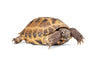
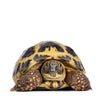
Hermann’s Tortoise Caresheet and Bioactive Habitat Maintenance

Testudo hermanni
Difficulty level: Intermediate
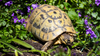
Hermann’s tortoises Testudo hermanni are diurnal, terrestrial chelonians native to arid and sub-mesic areas of Mediterranean Europe. These popular tortoises are only moderately difficult to keep, and are popular as pets due to their hardiness, relatively small size, and docile dispositions.
 Some of the trickiest aspects of keeping Hermann’s tortoises are their lighting and space needs, as well as keeping up with their diverse diet. Here’s an outline of how to care for a Hermann’s tortoise in a bioactive enclosure:
Materials needed for housing a Hermann’s tortoise:
- Appropriately-sized front-opening enclosure, as large as possible
- 75w Arcadia GoldenSun Basking Floodlight, x2
- Arcadia Ceramic Reflector Clamp Lamp, x2
- Bio Dude Digital Thermometer / Hygrometer, x2
- 22” Arcadia T5 HO Desert 12% UVB bulb
- 24” Bio Dude Solar Lamp Fixture
- 24” Bio Dude Solar Grow LED, x2
- Digital lamp timer power strip
- The Bio Dude Terra Sahara Bioactive Substrate Kit
- Arid springtails
- Dwarf White isopods
- Giant Canyon isopods
- Large, semi-arid plants
- Large caves/hides, x2
- Other décor items (rocks, hollow logs, cork flats, etc.)
- Water tray
- Cuttlebone
- Rep-Cal Herptivite multivitamin
- Dry food
Housing Requirements
Hermann’s tortoises are highly variable in size depending on sex and locality:
- Male Westerns: up to 4.5”
- Male Easterns and female westerns: up to 6”
- Female Easterns: up to 8”
Minimum acceptable enclosure size is calculated based on the expected adult length of the tortoise:
- Male T. h. hermanni: 36”L x 18”W x 9”H
- Female T. h. hermanni: 48”L x 24”W x 12”H
- Male T. h. boettgeri: 48”L x 24”W x 12”H
- Female T. h. boettgeri: 64”L x 32”W x 16”H
When in doubt, going with the larger option is always better. Tortoises may have a reputation for being slow, but as a grazing animal, they are quite active and will happily use as much space as you are willing to give them.
Recommended enclosures (depending on tortoise age and size):
- 36" x 18" x 18" Sliding Glass Door Habitat
- 4' x 2'x 2' (120 gallons) Sliding Glass Door Habitat
- The Bio Dude® Exclusive 4x2x2 with 7" Substrate Board
- The Bio Dude® Exclusive 6x2x2
Tortoises often have a hard time understanding glass barriers, and will waste a lot of energy trying to get through the glass. It’s best practice to have a good, tall opaque barrier at the front of the enclosure to help prevent the pacing.
Can Hermann’s tortoises cohabitate?
Yes, Hermann’s tortoises can be housed in the same enclosure, but this does not guarantee that they will get along. There’s no need to keep more than one. But if you want to keep multiple Hermann’s tortoises together, here are some rules you must follow to minimize the likelihood of conflict:
- Never house multiple males in the same enclosure.
- The enclosure needs to have an extra 5 square feet of floor space per additional tortoise.
- Set up extra basking and hiding spots to reduce competition.
- Do not house a male with female(s) unless you are willing to take on the responsibility of breeding.
If conflicts beyond minor scuffles occur, the tortoises must be separated immediately.
Substrate Requirements
Hermann’s tortoises are native to a semi-arid environment with sparse plant life and sandy, stony soil. It’s important to use a well-draining substrate that also allows for burrowing. If you want to set up a bioactive enclosure for your Hermann’s tortoise, you will need a substrate mix that is compatible with arid conditions, and will support the necessary microfauna (CUC) and plants.
You will need at least 6” of substrate in the enclosure. The Bio Dude’s Terra Sahara Bioactive Kit works well for semi-arid and arid species like Hermann’s tortoises. This kit includes everything you need for peace of mind in setting up a new bioactive enclosure: semi-arid soil mix, sphagnum moss, leaf litter, and The Bio Dude’s Bioshot soil inoculant.
You can’t have a bioactive enclosure without a good microfauna clean-up crew (CUC). For Hermann’s tortoise vivarium, a combination of arid springtails, dwarf white isopods, and giant canyon isopods are likely to do well in this environment.
Plan on setting the enclosure up at least 1 month in advance so your plants and CUC can get established without the strain of having to deal with a reptilian roommate. This is a great time to quarantine your new tortoise in a temporary enclosure, which will give you a chance to watch for illness, test for (and treat) parasites, and generally make sure you’re not introducing any pathogens into your new ecosystem. A quarantine enclosure should be set up much the same as the long-term enclosure, but with easily cleaned-décor and a temporary substrate like paper towels or clean cypress mulch, depending on your humidity needs. A large plastic tub makes for a good (temporary!!) quarantine enclosure.
Décor (Environmental Enrichment) Requirements
The more space and variation you give your tortoise in its environment, the more unique behaviors you’ll be able to see. In other words, it will be happier in its enclosure, and your pet will be more fun to watch, too.
Live, drought-tolerant plants are essential to a functional semi-arid bioactive enclosure. Their roots help keep your soil fresh, balanced, and clean! However, because Hermann’s tortoises are herbivorous, any plants that you put in the enclosure must be edible in case your pet decides to take a bite. Some candidates include:
- Aloe
- Echeveria
- Festuca grass
- Haworthia
- Sedge grass (Carex)
- Snake plant (sansevieria)
Use the largest plants that will fit in your enclosure, as these can provide shelter, are less likely to be severely damaged by your tortoise and will be more beneficial to your substrate. And make sure to quarantine them before adding them to your enclosure!
(A reality of keeping an herbivorous reptile in a bioactive setup is that you will likely need to replace devoured plants on a regular basis.)
Lighting/Temperature/Humidity Requirements
Lamps should be on for 12 hours/day. Alternatively, you can use a smart timer to sync your lamps with your local sunrise and sunset times for more natural seasonal variation.
Visible Light
Hermann’s tortoises are diurnal, so providing plenty of bright light in their enclosure is essential. Aside from better simulating the brightness of sunlight, it also helps create a distinct day-night cycle. Having a solid day-night cycle is important to healthy hormones (and therefore a healthy reptile!), but two heat lamps and a UVB is nowhere near bright enough for energizing your tortoise. Plus, arid-friendly plants need a lot of bright light to keep your bioactive setup needs to stay functional and healthy!
A bioactive Hermann’s tortoise enclosure should have enough LED bar grow lamps to span at least 75% of the enclosure’s length, but more is ideal, especially if you have an enclosure wider than 2’.
UVB
Appropriate exposure to high-quality UVB is essential to a tortoise’s wellbeing. We recommend providing a basking area with a UVI (UV Index) of 4.0-4.5 in order to make enough vitamin D3 and generally help keep your pet healthy. However, not all UVB lamps are high-quality (or even safe!). We recommend the Arcadia T5 HO Desert 12% if the lamp is placed over mesh, but the Forest 6% works if there is no mesh blockage. A 22” bulb will be enough to create a large enough basking area for an adult Hermann’s tortoise.
The strength of a UVB bulb diminishes with distance from the source, and mesh partly blocks the output as well. It’s best to measure the UVI at your basking spot with a Solarmeter 6.5 tool, but if that’s not an option, placing your basking area 12-13” below the 12% bulb should do the job. If you’re using the 6% inside the enclosure, the distance should be 10-11”.
Make sure to install your UVB bulb in a high-quality T5 HO fixture with a highly polished reflector. The Bio Dude Solar Lamp fixture is a good choice.
Heat
Like other reptiles, Hermann’s tortoises are cold-blooded, which means they need the right set of temperatures in their environment for their body to function properly. Here’s what your tortoise’s temperature gradient should look like:
- Basking area: 90-95°F
- Cool side: 68-86°F
- Nighttime (adults): 60-68°F
- Nighttime (hatchlings): >72°F
Use digital probe thermometers to keep track of the temperatures in the enclosure. Place one probe on the basking surface, and another probe on the cool end of the setup.
How do you heat a Hermann’s tortoise enclosure? All you need should be a couple of incandescent heat bulbs. Incandescent and halogen heat bulbs produce large amounts of sun-like infrared-A, unlike non-light emitting heat sources like heat projectors, ceramic heaters, and heat mats. This makes them the best and most natural way to help your cold-blooded friend regulate its metabolism!
Recommended heat bulbs:
-
Arcadia GoldenSun Basking Floodlight, 75-100w*
*A different wattage may be required to achieve the right basking temperature for your pet. Basking temperature varies based on basking distance, room temperature, and even the enclosure itself. Be prepared to experiment a little bit to create the correct environment for your pet.
A thermostat shouldn’t be used for micromanaging your basking temperature, but it’s a good safeguard against potential overheating. Plug your heat lamps into the thermostat, and place the thermostat’s probe on the cool end of the enclosure. The thermostat should be set to turn off the heat lamps at 87°F.
Note: Hermann’s tortoises need to be brumated each winter to maintain good health.
Humidity
Hermann’s tortoises may be a semi-arid species, but they need more humidity than you might assume. One of the biggest mistakes people make with grassland tortoises is keeping them too dry! Juveniles need high humidity levels averaging between 60-80%, and 40-70% for adults. To monitor your enclosure’s humidity levels, use a digital probe hygrometer, with the probe placed on the cool side of the setup.
A humid hide with moist sphagnum moss and/or substrate should be available at all times.
To increase humidity levels in the enclosure, the substrate on the cool side should be kept lightly moistened. It also helps to mist with a handheld pressure sprayer each evening (and in the mornings if needed). Keep in mind that humidity fluctuates are natural and normal, usually drier during the day and wetter at night. Letting the enclosure dry out a bit during the day helps prevent mold.
Don’t forget to water your plants as needed!
Dietary Requirements
Hermann’s tortoises are herbivores, which means that they eat primarily plant matter. In the wild, they have a highly varied diet. Try to replicate this variety as much as you can with your own pet’s nutrition. Pet Hermann’s tortoises should have a diet of primarily leafy greens and dried plants, with some flowers and vegetables for extra variety. Whenever possible, it’s best to grow your own tortoise food or gather it from chemical-free areas.
Safe greens for Hermann’s tortoises include: bindweed (Convovulaceae), broadleaf plantain (Plantago), opuntia cactus, clover, thyme, hawkbit, cucumber leaves, bean leaves, pea leaves, squash leaves, melon leaves, dandelion leaves, collard greens, green cabbage, kale, watercress, chicory, fennel, sprouts, spinach, carrot greens, romaine lettuce, tortoise hay.
Safe vegetables for Hermann’s tortoises include: cucumbers, green peas, pumpkin, green beans, squash, carrots.
Click here for a full list of edible plants for herbivore reptiles.
Flowers are an excellent addition to a Hermann’s tortoise’s diet, but they need to be gathered from pesticide- and pollution-free areas. Safe options include: clover, bindweed, chamomile, dandelion, geranium, hibiscus, honeysuckle, mallow, nasturtium, petunia, squash flowers, violet. Dried flower mixes like Bio Dude Flower Power also work in a pinch. If you're in the Greater Houston area, The Bio Dude brick and mortar store sells Red Clover Seeds!
Dry foods should be nutritious, high in fiber, and low in fillers. Good options for tortoises include Arids Only Uro Spice, SuperTortoise blends, Zoo Med Natural Grassland Tortoise Food, Mazuri Herbivorous Reptile Diet, Rep-Cal Juvenile Iguana Food, Tortoise Supply Herbal Tortoise Hay, and Arcadia Optimised 52. These can be offered alone or used as a salad “topper.”
Seeds can provide important extra nutrients, but should be used sparingly. Tortoise seed mix can be a great choice (e.g. Tortoise Supply).
Feeding schedule
Juvenile tortoises should be fed each morning, as much as they can eat. Subadults and adults should be fed a portion roughly equivalent to the size of their shell. However, adjust the feeding schedule and the size of each meal as needed to keep your pet in a healthy body shape. To help prevent your tortoise from swallowing substrate, always serve their food on a plate or tray.
Supplements
Calcium and multivitamin supplements are a good way to help make up for minor deficiencies in a reptile’s diet. For calcium, keep a cuttlebone in the enclosure at all times for the tortoise to chew on as needed. Add a light sprinkling of Rep-Cal Herptivite multivitamin on all salads for other important nutrients.
Supplements degrade over time, so supplements need to be replaced every 6 months to stay fresh and effective.
Water
Hermann’s tortoises need constant access to a shallow dish of clean drinking water. Flower pot saucers or trays work well for this purpose, as they’re large enough for the tortoise to soak in without being too deep. Target 2” deep for adults and 0.5” for juveniles. 1x/week (or as needed), give the tray a good scrub and a spritz with veterinary-grade disinfectant.

Maintaining Your Bioactive Hermann’s Tortoise Terrarium
Bioactive enclosures are often touted as low-maintenance, but there are still some things you need to do to keep your mini-ecosystem functional and thriving:
- Water the plants. Drought-resistant plants still need watering! If the substrate around your plant’s roots feels dry when you stick your finger about 1” into the soil, it’s time for water. Make sure to water the substrate around the base of each plant, not just dump water on top.
- Remove extra poo and urates. Although your CUC should take care of poo on the substrate, waste in hard-to-reach places may end up sitting there instead of getting broken down. Urates also need to be manually removed, as the CUC won’t touch those.
- Prune the plants. As your plants grow, some of them might start to overrun the enclosure. Trim them regularly with clean scissors or shears to keep an attractive shape and prevent a “leggy” appearance.
- Replace eaten plants. Your tortoise may or may not eat the plants in its enclosure. If your plants get damaged past the point of recovery, you will need to replace them with new, clean ones from a chemical-free grower.
- Add more biodegradables. Your CUC will break down your leaf litter and bark accents into soil over time, so you will need to add more once in a while.
- Add The Bio Dude’s BioVive. Throughout the life of your bioactive terrarium, some elements become depleted. Mix this into your substrate every 6-12 months as needed.
Written by Mariah Healey of ReptiFiles, 9/11/2026
- Josh Halter